
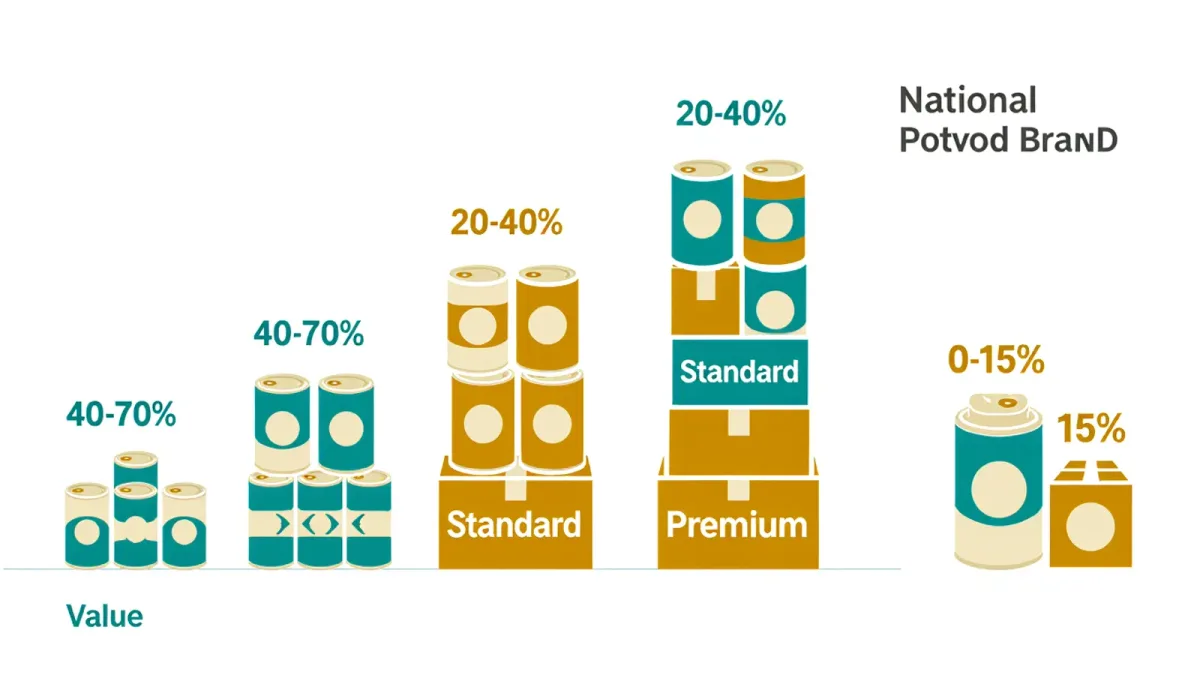
Store brands — private label — are frequently made in the same contract factories as the name brands beside them on the shelf, and they now represent a fifth of US grocery sales: private label dollar sales reached about $271 billion in 2024, a record share, per the Private Label Manufacturers Association and Circana data, checked July 2026. The typical saving over the national brand runs 20–40%, checked July 2026 — but the switch is smart for some categories and a mistake for others, and the label tells you less than the category does.
This guide explains who actually manufactures private label, what the tiers mean, and where switching saves real money without trading away quality. This publication publishes information, not financial advice.
Who makes store brands?
Three maker types, checked July 2026:
- Co-packers to everyone: large contract manufacturers produce both national brands and retailer label lines on the same lines. Well-known examples span canned goods, frozen vegetables, over-the-counter medicines and batteries — regulators require the same facility standards and labeling rules regardless of whose logo is on the front.
- Brand-owned production: sometimes the national brand itself fills your supermarket's label under contract during spare capacity.
- Retailer-owned factories: the largest retailers (Costco, Aldi, and European grocers especially) own dedicated production or commission exclusive specs, which is how premium tiers like Kirkland Signature distinguish themselves.
The consequence: identical ingredients lists on a national brand and a store brand usually mean genuinely similar contents — food labeling law requires the ingredients to be listed in order and truthfully. What differs is often the recipe's fine print, QC tolerances and packaging, not the factory's hygiene.
What do the private label tiers mean?
| Tier | Positioning | Typical price vs national brand |
|---|---|---|
| Value / white box | Plain packaging, basic spec | 40–70% cheaper, checked July 2026 |
| Standard label | The store's main brand | 20–40% cheaper |
| Premium private label | Own specs, sometimes superior ingredients | 0–15% cheaper, occasionally priced above mid-tier brands |
Related stories: Why Stores Added Self-Checkout — and Why Some Are Ripping It Out · Why Are Department Stores Disappearing? The Economics, Explained for Shoppers.
Where should you always switch to store brands?
- Staples with legal specs: sugar, salt, flour, milk, eggs, baking soda — regulated commodities where the national brand adds a logo, checked July 2026.
- Over-the-counter medicines: store-brand ibuprofen or allergy pills carry the same active ingredient and dosage by FDA generic-drug rules; pharmacists confirm the equivalence on request.
- Canned and frozen basics: tomatoes, frozen vegetables, beans — the co-packer overlap is widest here.
- Batteries and paper goods: name-brand factories produce many store lines; trial one pack before buying bulk.
Where should you stay with the name brand?
- Signature recipes: cola, ketchup, specific cookies — the recipe is the product, and the store version is an imitation of it, sometimes close, sometimes not.
- Consistency-critical cooking: professional bakers spec particular flours and chocolates; home baking rewards the same care.
- Items where failure is expensive: paint, adhesives, some cleaning chemistries — a failed batch costs more than the saving.
- Children's car seats, helmets, safety gear: this is not a brand-snobbery category; check certification and testing records rather than chasing the cheapest label on the shelf.
Why did private label grow so fast?
The 2022–2024 inflation cycle pushed shoppers across the aisle in record numbers, and retailers answered by upgrading their premium tiers — the growth continued even as inflation cooled, per PLMA/Circana reporting checked July 2026. European markets lead: private label holds roughly 30–50% shares across much of Western Europe, versus about 20% in the US — a gap that says more about retailer concentration than product quality.
How do you compare properly?
Read the ingredients list, not the box: order and content reveal overlap instantly. Compare unit prices, which store shelves must display. Then trial on a single unit — the private label experiment costs one purchase, not a pantry.
The bottom line
Store brands are a factory story, not a quality story: the same lines, the same legal standards, minus the marketing budget that the national brand charges you for. Switch the commodities and the medicines, keep the signature recipes, and let the 20–40% saving prove itself one unit at a time.
How did premium store brands get so good?
The premium tiers came of age when retailers hired real product developers and commissioned exclusive specs instead of copying national-brand formulas — Costco's Kirkland Signature is the canonical case, with documented arrangements where well-known manufacturers produce the label line to retailer specification, checked July 2026. Aldi and Trader Joe's built their entire model on exclusive private label. The result is a market where the store brand is sometimes the quality leader, which would have sounded absurd to a 1990s shopper and is now simply shelf reality.