
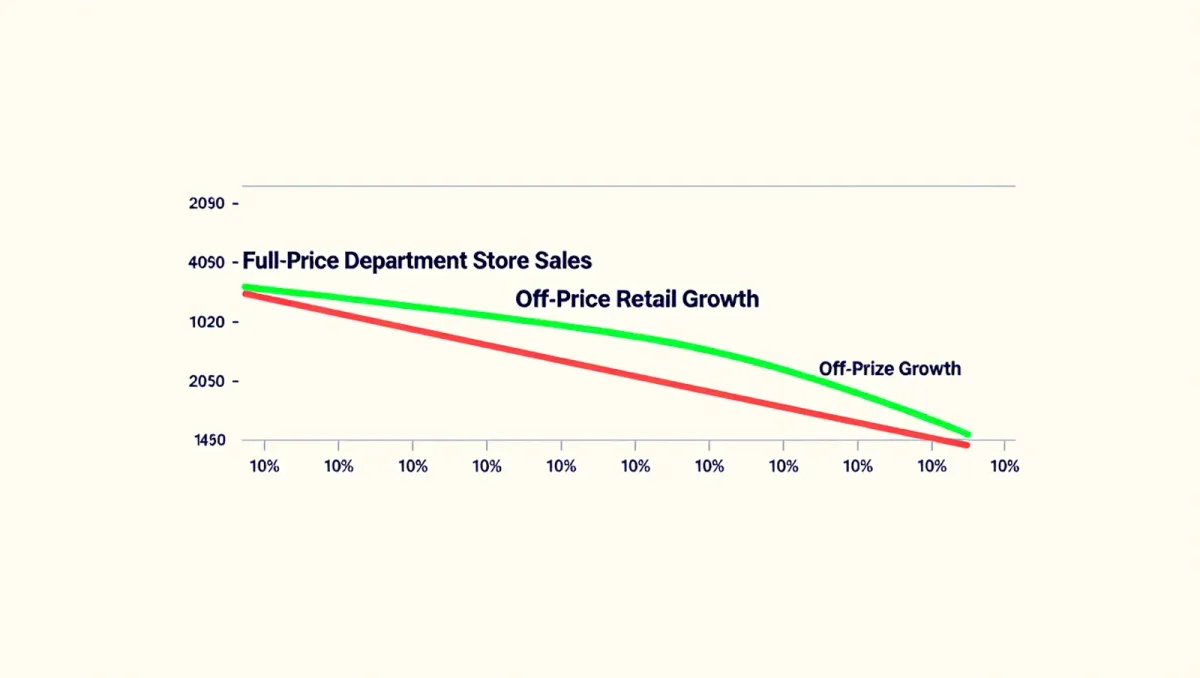
The American department store is splitting in two. Kohl's reported fourth-quarter fiscal 2025 net sales down 3.9% with comparable sales off 2.8% on March 10, 2026, and guided fiscal 2026 to adjusted earnings of $1.80–$2.00 per share with net sales expected to decline modestly, per the company's earnings release. On the other side of the split, Nordstrom — taken private in a roughly $6.25 billion buyout completed in May 2025 — is expanding its off-price Rack chain, where S&P Global reported net sales growth of 11% with comparable sales up 8.5%.
For shoppers, the split defines where the department-store value actually lives this year: the off-price wing, not the anchor floor.
What does Kohl's guidance mean for its shelves?
A chain guiding to lower sales manages two ways: cut costs and protect margin. For shoppers that usually means leaner staffing and slower replenishment on slow-turning categories, but also sustained promotional intensity, because a shrinking chain must defend traffic. Kohl's coupon-and-cash-back ecosystem — already among the most layered in retail — is unlikely to thin out in 2026; expect the stack of percent-off codes, cardholder events, and loyalty incentives to remain the real price of the store, with sticker prices as the opening bid.
Related stories: February's Late Retail Sales Report Showed Spending Up 0.6% — and Slower Post-Holiday Momentum · Tariffs Reach the Shelf: Which Prices Are Moving and How Shoppers Are Responding.
Why is the off-price wing winning?
Nordstrom Rack's 11% growth (per S&P Global reporting, 2026) tracks an industry pattern: manufacturers overproduced through the tariff uncertainty of 2025, and excess goods flow to off-price channels at deep discounts. The Rack format, along with TJX chains and Burlington, buys that excess and prices it 20–60% under department-store ticket. When a full-price chain struggles, its own excess inventory feeds the off-price competitor — including, historically, Nordstrom's full-line stores feeding the Rack.
What should a department-store shopper change?
- Price the off-price version first: before buying apparel, home goods, or shoes at anchor pricing, check the same brands at Rack, TJ Maxx, or Burlington — the identical or prior-season goods commonly run far cheaper.
- Use full-line stores for fit and newness, then buy clearance there or the current-season item off-price.
- At Kohl's specifically, never pay the sticker: run the stack of sale, coupon, and loyalty pricing, which routinely lands 30–40% under ticket.
- Watch store-closure lists: anchors leaving malls are negotiating from weakness, and their liquidation-adjacent clearance can be genuinely cheap — with final-sale terms attached.
Is the department store dying again?
Not dying — bifurcating. The full-service middle keeps contracting, while the off-price arm of the same industry grows double digits. Shoppers lose the browsing experience and the convenience of one roof; they gain a market where last season's goods are persistently oversupplied. The 2026 play is to shop the oversupply.
Figures per Kohl's Q4 FY2025 earnings release (March 10, 2026) and S&P Global reporting on Nordstrom, 2026.