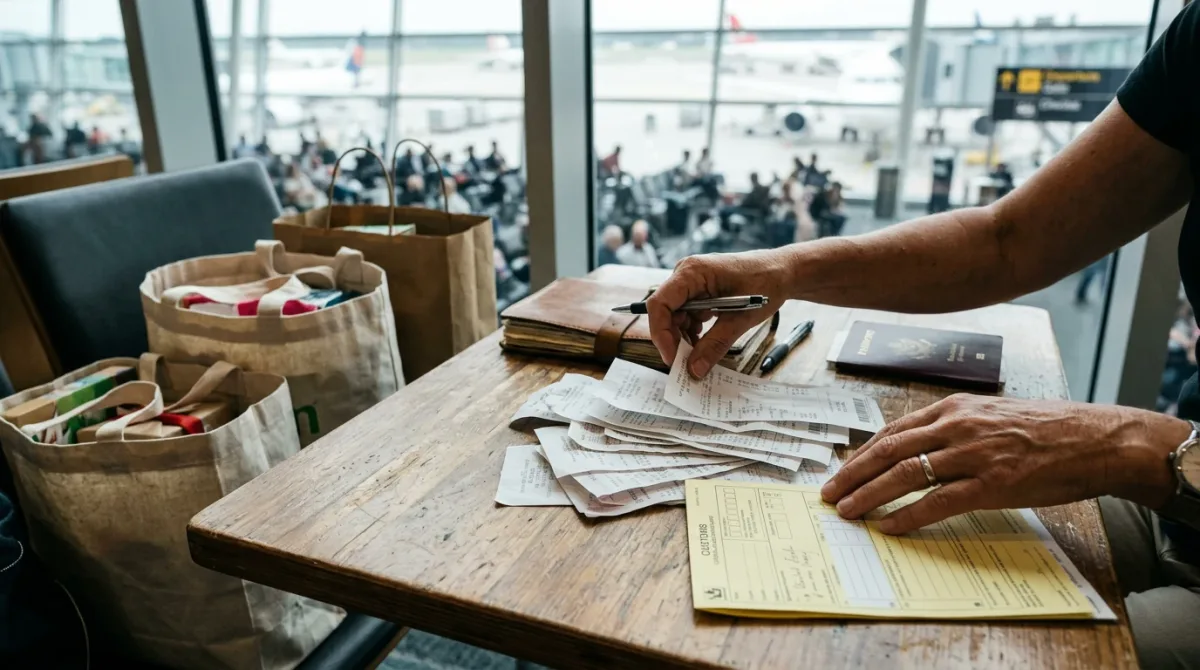
Most U.S. residents get $800 in duty-free purchases per trip before Customs and Border Protection can charge you anything, as of CBP guidance checked August 20, 2026. That figure drops to $200 if you've been out of the country less than 48 hours or have already used an exemption in the past 30 days, and it rises to $1,600 if you're returning from the U.S. Virgin Islands, American Samoa, or Guam. Skip the myth that CBP is hunting for souvenirs — the real risk is undeclared goods, not a $60 scarf.
What exactly is the $800 exemption?
The exemption is the total retail value of goods you can bring home without paying duty, per person, per trip, according to CBP's "Types of Exemptions" page. It applies on most returns from abroad, including trips through Caribbean Basin and Andean countries. Within that $800, you can include up to two liters of alcohol as long as at least one liter was produced in a beneficiary country, plus gifts and CBP-recognized duty-free items like original fine art, which CBP says don't count against the cap at all.
Family members traveling together can pool their individual exemptions. A couple gets a combined $1,600 before anything is dutiable, and a family of four gets $3,200 — but each person still has to have actually traveled and be declaring the goods themselves; you can't claim your spouse's $800 if they stayed home. The $200 exemption is different: CBP is explicit that "family members may not combine their individual $200 exemptions," so if you fall into that shorter-trip category, each traveler is capped separately, with a maximum of 50 cigarettes, 10 cigars, and 150ml of alcohol or perfume folded into that lower ceiling.
What happens if I go over $800?
Nothing dramatic — you pay duty on the amount above the exemption, and CBP's guidance is blunt about the bigger risk: failing to declare something you should have. Per CBP's "What to Expect When You Return" page, undeclared items can be seized outright, which is a worse outcome than just owing tax on a purchase you were upfront about. When in doubt, declare it and let the CBP officer sort out what's owed rather than guessing wrong at the kiosk.
How do I actually declare what I bought?
- Save your receipts as you shop. CBP's return-trip guidance says organized receipts are what make the declaration process fast; without them you're estimating values, which invites scrutiny.
- Fill out CBP Declaration Form 6059B, itemizing purchased merchandise and any agricultural products, before or as you arrive — paper form, a Global Entry kiosk, or an Automated Passport Control kiosk all work, per CBP.
- Total the retail value of everything you're bringing back that isn't a personal item you traveled with originally (your own camera or laptop doesn't count; new items you bought or received as gifts do).
- Answer CBP officer questions honestly about your trip and purchases. Officers are authorized to search baggage and vehicles, and CBP notes you can request a supervisor or call the CBP INFO Center at 877-227-5511 if you have a dispute over how you were treated.
What about VAT refunds I claimed overseas?
A separate pot of savings exists before you even reach U.S. Customs: value-added tax refunds available in many countries outside the U.S. Shops that display a "Tax Free Shopping for Tourists" sticker handle the refund paperwork at the time of purchase, and minimum purchase thresholds to qualify typically run in the roughly $50–$200 range depending on the country, per travel-shopping guidance from NBC News. You claim the actual refund at an airport counter — commonly at your final departure point from the destination region — and processing can take anywhere from a couple of weeks to several months. That refund is separate from, and has no bearing on, the U.S. duty-free exemption; a VAT-refunded purchase still counts toward your $800 when you land back home.
Does duty-free airport shopping avoid this entirely?
No — and this is the most common shopper confusion. "Duty-free" at the airport you're departing from means you didn't pay that country's local sales tax or duty on the purchase there. It says nothing about U.S. Customs. Anything you buy in a duty-free shop overseas still has to be declared and still counts toward your $800 (or $1,600, or $200) exemption when you re-enter the United States. The savings on duty-free alcohol, perfume, and tobacco can be real — NBC News's shopping-tips coverage notes those categories can run noticeably below normal retail — but treat it as a discount on the item, not an exemption from declaring it.
This article explains general U.S. Customs and Border Protection rules and is not legal advice. Duty rates, exemption amounts, and prohibited-item lists change; confirm your specific situation against current CBP guidance or a licensed customs broker before you travel.
For a related shopping news perspective, read How Much Can You Bring Home Duty-Free From a Shopping Trip Abroad?.
For more context, read How Much US Customs Duty Will You Actually Pay on Souvenirs?.
For more context, read Is ChatGPT's free plan enough for your actual workday?.
For more context, read online.