
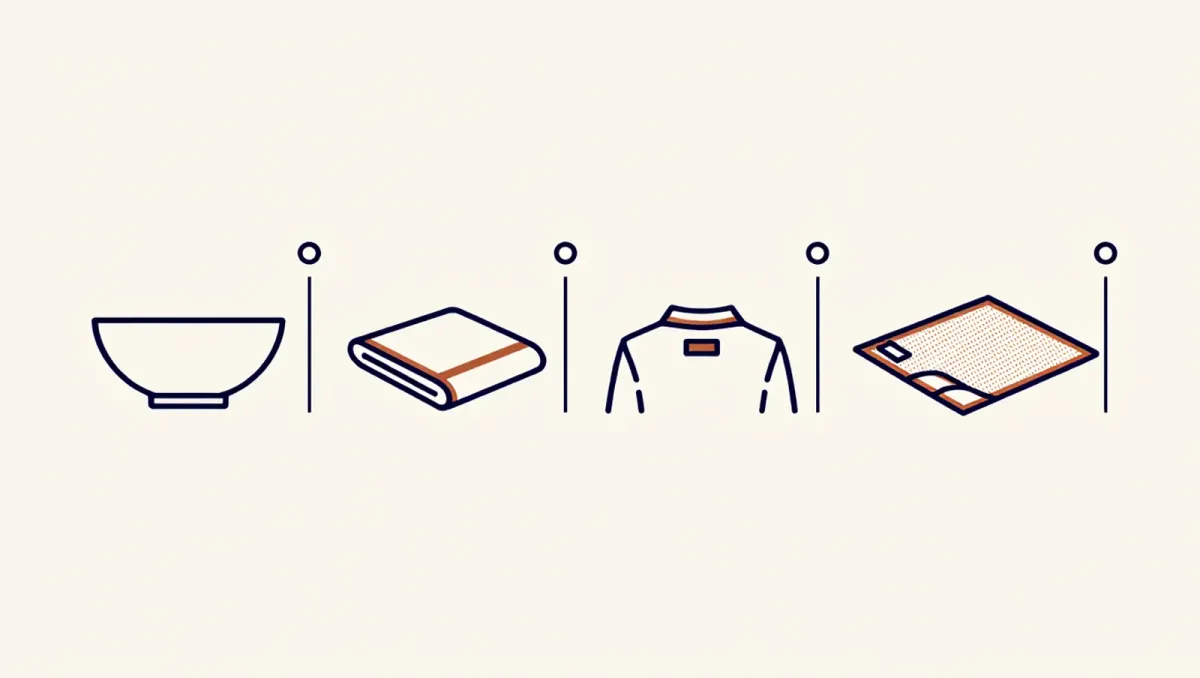
The fastest honesty check on any ceramic or textile is on the back or the edge: fired backstamps on pottery, woven selvages on fabric, sewn labels on finished goods. A genuine origin mark is applied during production and is hard to fake convincingly; a paper sticker or an ink stamp added after the fact is worth nothing. As of 2026, most major producing countries require origin labeling on imports — but the requirement disciplines retailers, not market stalls, which is exactly why you need to read marks yourself.
This is consumer information, not legal advice.
What should you look for on ceramics?
Turn the piece over. A porcelain or earthenware backstamp — painted under the glaze, incised into the clay, or impressed — identifies the factory, and often the painter's initials and a date code. Under-glaze and impressed marks are applied before firing and cannot be added afterward; over-glaze printed marks are easier to fake. Recognizable honest patterns: Japanese porcelain carries factory marks plus "Made in Japan"; Portuguese and Spanish pottery often shows workshop initials and town; Mexican folk pottery is typically signed by hand rather than stamped, which is itself the tell of a working studio. A piece labeled with a famous factory name in a modern-looking decal deserves skepticism — decal forgery of classic marks is a documented trade.
What do textile marks hide or reveal?
Three places to look. The selvage — the self-finished edge of woven cloth — sometimes carries the mill's name woven into the fabric itself, a practice common in Japanese and Italian denim and wool. Labels on finished goods should state fiber content and country of both weaving and sewing; the two can differ, and "woven in Italy, sewn in Romania" is legitimate but worth knowing for the price you're paying. Hand-loomed cloth often carries a cotton thread marker or the weaver's knot pattern at the corner instead of any printed label — regional weaving cooperatives in Guatemala, Oaxaca, and the Otavalo region of Ecuador use cooperative tags that trace to a named group of makers.
Related stories: Italian and Portuguese Leather Shoes: How to Judge Quality Before You Pay · Flea Markets: The Seven Finds Worth Buying and Three to Leave Behind.
Which marks legally mean nothing?
- "Handmade" — unregulated in most markets as a standalone word; a machine-thrown, hand-painted piece qualifies.
- "Genuine" and "authentic" — pure marketing vocabulary with no defined standard.
- Flag or landmark graphics — a picture of a Portuguese rooster proves nothing about where the rooster was fired.
- Stickers — removable, therefore unreliable; check for a mark fired or woven into the good itself.
What does provenance do to price?
Real origin marks move prices in both directions, and the shopper who reads them pays less, not more. A studio-signed Mexican or Portuguese ceramic typically prices at €25–€70 (checked May 2026) — comparable to anonymous imports at design shops but traceable. Factory-marked vintage Japanese or Italian tableware at flea markets often prices below new unmarked equivalents because sellers can't read the marks; a verified factory stamp can be the difference between a €12 plate and a €120 one. On textiles, cooperative-traced weavings commonly price 20–40% above anonymous market stalls (checked May 2026), which is the honest premium for a named maker.
How should you buy from a market stall?
- Ask where it was made, and listen for a town or workshop, not a country.
- Check for a fired, woven, or signed mark — production-time evidence beats any paper.
- Ask one follow-up question about the mark; sellers who know their goods answer specifically.
- Price against both the import shop and the cooperative; two data points beat one.
None of this makes a beautiful anonymous bowl a bad buy. It makes it a correctly priced one — a decoration, not a documented craft. Both are legitimate purchases; only one deserves the craft premium.