
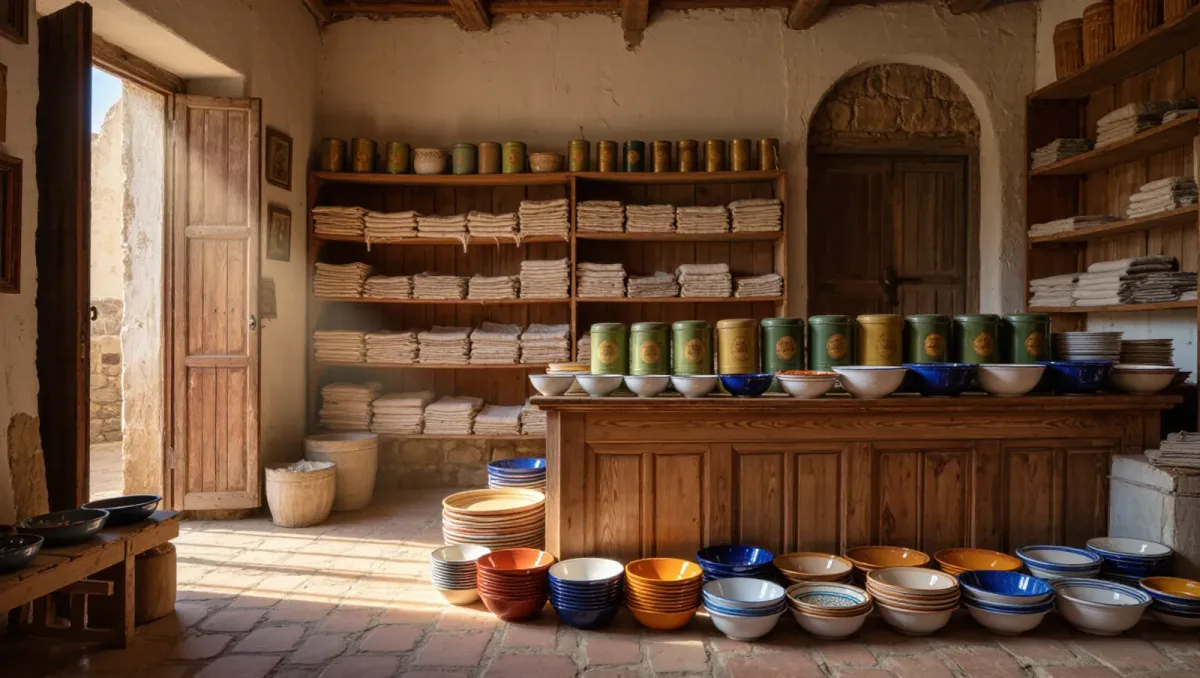
The best travel gifts share three properties: they cost meaningfully less at the source than at home, they survive a week in a suitcase, and they say something about the place that a fridge magnet can't. As of 2026, that puts olive oil, ceramics, knives (checked luggage only), textiles, and regional food staples at the top of the list — and puts logo mugs, mass-produced "local" crafts, and anything fragile-without-a-box at the bottom. Buy for the recipient's kitchen and shelves, not for your itinerary.
Every price below is illustrative with currency and the date checked; re-verify locally.
Which gifts survive the suitcase?
- Sealed food: olive oil, spice blends, honey, chocolate. Sealed tins and jars survive handling; a glass jar of anything wrapped in a sock survives most checked-bag reality. Expect roughly €8–€15 for a good 500 ml tin of Greek or southern Italian olive oil at a grocery (checked March 2026) versus two to three times that for the same grade at home.
- Textiles: scarves, tea towels, throws. They crush instead of breaking, and a €30–€60 linen tea towel from a local weaver (checked March 2026) reads as a considered gift.
- Small ceramics: bowls and cups packed in the middle of the suitcase, not the edges. Skip platters and lamps unless you're shipping.
What should you skip?
Skip anything with the destination's name stamped on a generic object — those are imported in bulk and marked up at the airport. Skip liquor unless the recipient is a drinker of that specific thing; a €25 bottle (checked March 2026) is a gift only if the person would spend €25 on it themselves. And skip perishable charcuterie and fresh produce across any border: many countries restrict animal products in passenger baggage, and a seized sausage helps nobody. Check your home government's food-in-baggage rules before you buy, not at the arrivals hall.
Related stories: Flea Markets: The Seven Finds Worth Buying and Three to Leave Behind · Comparison Shopping Apps and Price Trackers: Which Tools Actually Save Money.
Where should you buy?
Two rows in, as the house rule goes. Grocery stores beat airport shops on sealed food by 30–50% for identical products. For crafts, look for a maker's stamp, workshop address, or a named cooperative — real production leaves traces. Markets are for atmosphere and bargaining; specialist shops are for gifts that need to look considered. A person who sells only ceramics usually knows more and misrepresents less than a stall selling everything.
How much should a travel gift cost?
Decide the budget per recipient before the trip and hold it. The honest structure: €10–€20 (checked March 2026) buys a consumable that says "I thought about you in Lisbon"; €40–€80 buys a craft object with a maker behind it; above that, you're buying an object the recipient must house, which is a different social contract. A $70 knife is a gift for someone who cooks; the same $70 in a nice olive-wood board suits almost anyone.
How do you pack gifts home?
Pad ceramics in clothing in the suitcase's center, belt the lids with rubber bands, and pack liquids double-bagged. Knives must go in checked baggage — pack them at once so they never meet a carry-on scanner. Keep receipts together in one envelope: useful for insurance if the bag goes missing, and necessary paperwork for anything you ship commercially. If a gift is fragile and expensive, shipping it home with insurance usually beats carrying it; parcel prices vary widely, so quote it at the shop counter before deciding.
The strategy in one line
Buy the destination's honest staple, not its souvenir: the oil, the towel, the bowl from the person who made it. The gift that travels best is the one that would still have been a good gift if you'd bought it at home — except you got it fresher, cheaper, and with a story attached.