
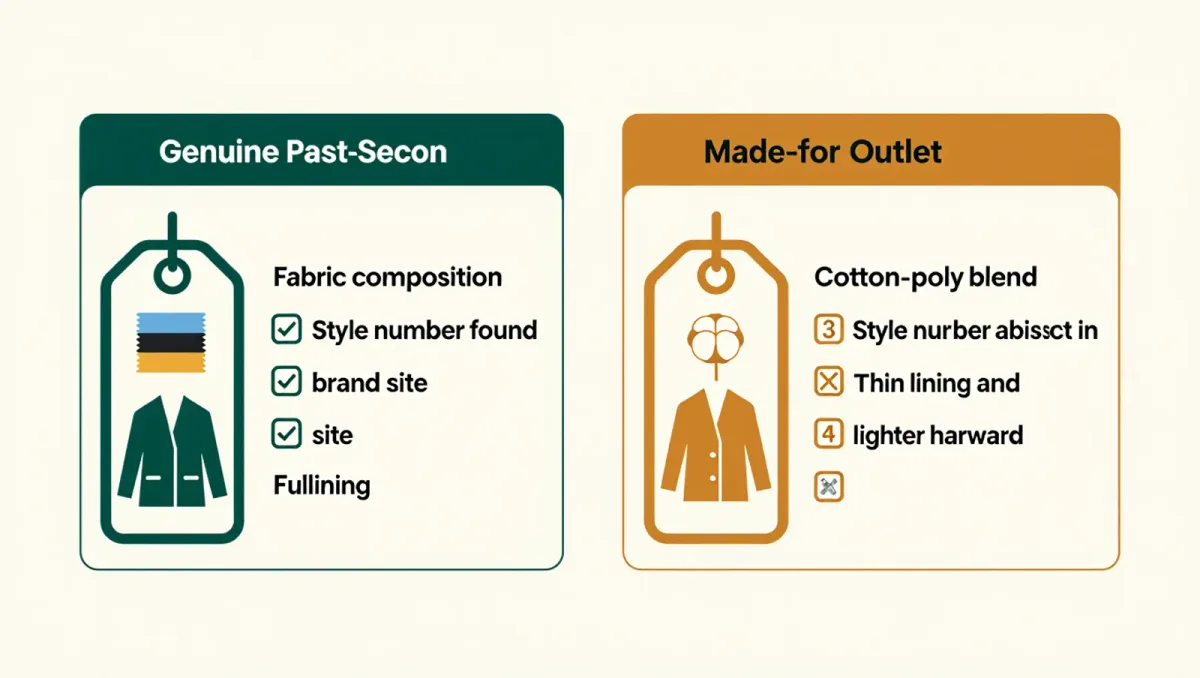
European outlet villages work on a simple split: some stock is genuine last-season merchandise at 30–70% off the original RRP, and some is manufactured-for-outlet lines — goods produced specifically to be sold at a discount, often with lower-spec materials. Consumer authorities in the US and EU have documented the practice for years, and European operators' own labeling now has to distinguish it: under EU rules enforced since 2022, price-reduction announcements must state the prior price, per the EU Omnibus Directive price-reduction rules, checked January 2026.
The villages themselves — Bicester Village near London, La Vallée Village near Paris, Wertheim and Ingolstadt Villages in Germany, La Roca Village near Barcelona, plus Value Retail's and McArthurGlen's other sites — remain useful stops. The skill is reading the tags. This publication publishes information, not purchase advice.
How do you tell outlet-made goods from genuine past-season stock?
- The fabric tag. Genuine mainline carryover usually shows the season's composition and care standards of the boutique line. Manufactured-for-outlet pieces often use cotton-poly blends where mainline used full cotton, thinner leather, or simplified linings.
- The style number format. Many brands use distinct SKU prefixes or a different label stitching for outlet channels; comparing the style number against the brand's own website shows whether the piece ever existed in mainline.
- The single-store test. If the item appears on the brand's website only in outlet listings, or nowhere, that is your answer.
- The stitch and hardware check. Cheaper zips, lighter buttons and simpler finishing mark the made-for-outlet tier in mid-market brands especially.
What are the discounts actually against?
The sign says 50% off; the question is off what. Under the EU Omnibus rules, any advertised reduction must reference the lowest price charged in the previous 30 days, per EU Directive 2019/2161 enforcement guidance, checked January 2026 — which curbed the old trick of inflating a “reference price.” Still, comparing against what the item actually costs elsewhere — the brand's own outlet website, department store sales, resale platforms — is the only comparison basis that matters. A “deal” claim is only as good as its baseline.
Related stories: Does Cutting Out the Middleman Actually Cut Prices? DTC Brands, Explained · The Secondhand Economy: Why Your Vintage T-Shirt Costs More Than a New One.
Which categories hold value at outlets — and which do not?
| Category | Outlet reality |
|---|---|
| Past-season luxury leather goods | Strong buy; leather quality rarely differs across lines at top brands, checked January 2026 |
| Classic tailoring and coats | Strong buy; styles date slowly |
| T-shirts, knitwear, casual lines | Weak buy; this is the made-for-outlet heartland |
| Sneakers and sportswear | Mixed; many models exist only for the outlet channel |
| Homeware and luggage | Mixed; check zips, wheels and lining specs carefully |
Do outlet villages run extra sales?
Yes, and they are calendar-driven: January and July clearances stack store-level reductions on top of the outlet price, and village-wide shopping nights and seasonal events add further vouchers, per operator calendars for 2025–26, checked January 2026. The tourist mechanics matter too: the villages sell gift cards, run express parking, and — critically for visitors — operate VAT refund services for non-EU residents, which adds roughly 10–12% effective saving on top of the ticket discount, processed at departure per standard European VAT-refund rules.
Is the VIP discount scheme worth joining?
The operators' free membership apps (Value Retail's and McArthurGlen's schemes) add a further 10% at participating boutiques for first visits and event vouchers afterward. For a single dedicated shopping day, the extra 10% on an already-discounted price usually makes it worthwhile, checked January 2026; there is no meaningful catch beyond the marketing data you hand over.
How do you plan a village day?
- Decide the target list before arriving — open-ended outlet browsing is how manufactured-for-outlet goods get bought.
- Check each item's style number online on the spot.
- Shop the calendar: the second half of January and of July carry the deepest stacked reductions.
- Keep receipts for the VAT refund and process it at the airport — unprocessed, the saving evaporates.
The bottom line
Outlets are where fashion goes to be marked down honestly and manufactured to be marked down profitably. Buy the leather, the tailoring and the classics; check the style number on everything else.
How do the big villages compare?
Roughly, by orientation: Bicester and La Roca skew luxury and tourist-heavy with the deepest brand rosters; La Vallée trades on Paris proximity and weekend crowds; the German McArthurGlen sites (Wertheim, Ingolstadt, Metzingen's Hugo Boss heartland) run the broadest mid-market selection at slightly lower base prices, checked January 2026. Metzingen deserves its note — the factory-town roots mean some outlet stock is literally made nearby, and the premium-tier terms there are the most transparent of the lot.